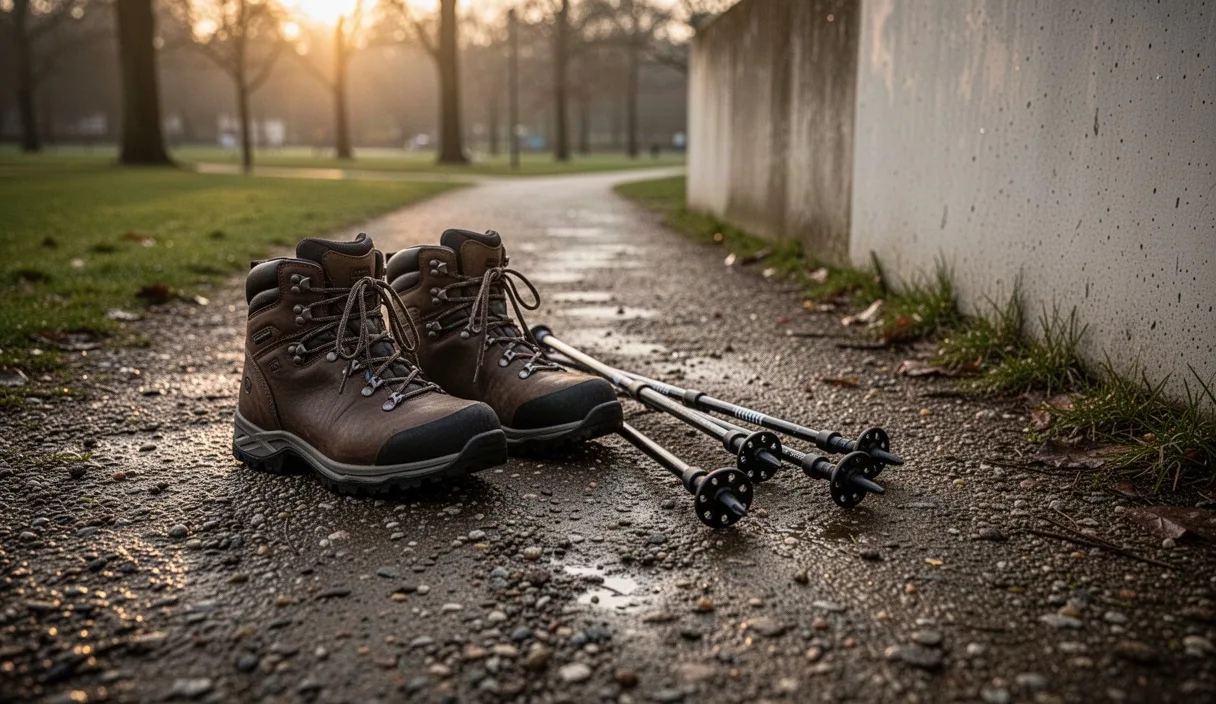
When you stop by our shop to ask about poles, the conversation usually starts the same way. You already walk three or four miles a day, your shoes fit well, and you enjoy your neighborhood route. You wonder whether carrying a pair of Nordic poles actually changes anything, or if it is just regular walking with extra gear in your hands. It is a fair question, and one we hear almost every morning.
Walking without poles is one of the most natural things human bodies do. Nordic walking takes that familiar movement and layers a cross-country skiing mechanic on top of it. Once you learn to push backward against the ground through the pole straps, the mechanics of how you move shift in noticeable ways. Below, we break down the practical differences between the two styles so you can decide what makes sense for your daily route.
How Upper Body Engagement Changes the Gait
During a standard stroll, your legs handle nearly all the physical work. Your arms swing naturally to counterbalance the rotation of your pelvis, but that swing is mostly passive momentum. Your shoulders, upper back, and chest muscles remain relatively relaxed, doing little to move you down the trail. For a simple walk to clear your head, that low demand is perfectly fine.
Nordic walking turns that passive arm swing into an active propulsion stroke. Because your hands are strapped into ergonomic grips, you push down and backward through the pole shaft with every stride. That push recruits the triceps, the posterior deltoids, the latissimus dorsi, and the muscles between your shoulder blades. Your core muscles, especially the internal and external obliques, engage automatically to transfer force from your upper body into your forward step.
This upper-body drive changes your lower-body mechanics as well. When your arms actively push backward, your pelvis moves forward more freely. Most walkers notice their stride lengthens slightly without any conscious effort to take bigger steps. You also get a distinct cross-body rotation through your ribs, where the left shoulder moves forward in harmony with the right hip, creating a balanced, rhythmic gait.
| Body Area | Regular Walking | Nordic Walking |
|---|---|---|
| Arms and Shoulders | Passive swing from the shoulder socket | Active rearward push engaging triceps and deltoids |
| Upper Back and Lats | Minimal continuous tension | Consistent contraction on every backward push |
| Core and Obliques | Stabilizing upright balance | Active rotational stabilization during ground drive |
| Legs and Hips | Primary propulsion source | Shared propulsion alongside upper torso work |
Joint Impact Differences on Hard Surfaces
Pavement, concrete sidewalks, and packed gravel send ground reaction forces straight up through your heels, knees, and hips. In standard walking, each heel strike carries roughly 1.2 to 1.5 times your body weight. Over a 45-minute outing on asphalt, those repetitive impacts add up. If you manage knee stiffness or hip sensitivity, you know exactly how that cumulative pressure feels by the time you reach your front door.
When you plant a Nordic pole, you plant it at an angle behind you, just as your front foot makes contact with the ground. As you press through the wrist strap, a portion of your weight transfers through your arm, through the pole shaft, and directly into the road. Studies on gait biomechanics show that this load-sharing reduces peak ground reaction forces on the knees and lower spine by roughly 13% to 17% compared to normal walking at the same pace.
The equipment also makes a difference here. Nordic walking poles use angled rubber tips, often called paws, for walking on hard surfaces. These rubber tips cushion the strike and absorb high-frequency vibrations before they reach your wrist and elbow joints. If you are recovering from an injury or dealing with persistent joint pain, we always suggest speaking with your physical therapist or doctor first, but many find that pole support makes pavement walking much more comfortable.
Postural Alignment and Spinal Support
Look around any local park and you will see how gravity and daily desk work affect standard walking posture. Many of us round our shoulders forward, drop our chins toward our chests, and let our lower backs arch or flatten out. Over several miles, walking with rounded shoulders can compress the rib cage and tighten the muscles across the front of the chest, leading to neck aches and shallow breathing.
Nordic walking acts as a gentle, continuous posture check. Because the pole pushes down and back behind your hip, your chest naturally stays open. To plant the pole effectively, you have to keep your eyes forward rather than staring at your shoes. That eye line helps align the cervical spine with your shoulders. As your latissimus dorsi and rhomboids fire during the push phase, they draw your shoulder blades down and back, away from your ears.
The technique also encourages healthy thoracic spine rotation. In everyday walking, a stiff mid-back causes the lower back to twist excessively to compensate. Nordic walking stabilizes the lumbar spine through core engagement while encouraging gentle rotation through the rib cage. You can focus on a few basic alignment cues while you walk:
- Keep your breastbone pointed forward rather than angled toward the dirt.
- Allow your arms to swing straight forward from the shoulder joint, avoiding an inward cross over your belly button.
- Release your grip slightly on the backward push, trusting the strap to support your hand pressure.
- Keep your chin level, looking roughly 15 to 20 feet ahead along your path.
Caloric Expenditure and Heart Rate Observations
Because regular walking relies mostly on your lower limbs, your oxygen demand and energy burn reflect the work of those specific leg muscles. If you want to increase your effort during a standard walk, your main choices are walking faster or finding a steep hill. While increasing speed works, fast walking can sometimes feel jerky or awkward once you pass roughly 4.2 miles per hour.
Nordic walking increases your energy output without requiring you to sprint. By bringing large upper-body muscle groups into the movement, your body consumes more oxygen to fuel the extra muscle tissue. Field research, including classic trials conducted at the Cooper Institute, indicates that Nordic walking burns between 18% and 23% more calories than regular walking at an identical speed on flat ground.
Your cardiovascular system responds in kind. Heart rates during Nordic walking typically sit about 12 to 16 beats per minute higher than in standard walking at the same velocity. What makes this interesting is the rate of perceived exertion. Because that extra workload is spread across your chest, back, arms, and legs rather than concentrated solely in your calves and thighs, most walkers report that the workout does not feel noticeably harder. You breathe a bit deeper and work your heart more, but your legs feel fresh.
Rhythm and Pacing Differences
Regular walking is forgiving when it comes to tempo. You can slow down to browse a shop window, pick up your pace across an intersection, or pause mid-stride to glance at a bird. Your arm swing naturally speeds up or slows down alongside your feet without much thought. It is an intuitive, unstructured movement that requires zero technical focus.
Nordic walking relies on a deliberate, metronomic cadence. The rhythm mirrors your natural contralateral gait: your left arm plants when your right heel strikes, and your right arm plants when your left heel strikes. If you lose focus and let your arm and leg on the same side move together, the rhythm breaks instantly. It usually takes a beginner about 15 minutes of quiet concentration to lock the timing into muscle memory.
Once you find the groove, Nordic walking tends to settle into a steady, brisk pace, typically between 105 and 115 steps per minute. The release and catch of the pole grip creates an ongoing cadence: plant, press, release behind the hip, swing forward, catch, and plant again. This continuous cycle gives the walk an almost meditative feel, keeping your pace steady across flat pavement, gentle rises, and open trails alike.
Choosing Which Style Fits Your Daily Goals
Neither style is inherently superior to the other. They simply serve different purposes in your week, and we often tell our customers to keep space for both. The right choice depends on where you are going, who you are with, and what you want out of that specific hour outside.
Standard walking is unmatched for daily convenience. You do not need to carry straps, adjust pole lengths, or swap rubber asphalt paws for metal trail spikes. If you are walking a lively dog on a leash, pushing a stroller, or taking a relaxed walk with a neighbor where you want to stop and chat, ordinary walking is the practical answer. It keeps you moving without any logistical friction.
Nordic walking is the better tool when you treat your walk as a dedicated, low-impact workout. It turns flat, ordinary neighborhood streets into a full-body conditioning session. It is also an excellent option for cross-training on days between runs or cycling sessions, or when you want the fitness benefits of jogging without the joint impact. If you want upper-body toning, posture work, and higher cardiovascular demand, reaching for the poles makes sense.
Common Mistakes to Avoid
When people try Nordic walking without instruction, they often treat the poles like hiking sticks. Here are four common errors we see on the trails and how you can correct them:
- Planting poles in front of your toes: Trekking poles go in front for downhill braking, but Nordic poles must always point diagonally backward at roughly a 45-degree angle to drive you forward.
- Squeezing the grips constantly: Holding the handles in a death grip tires your forearms. Let the wrist strap bear your weight, and open your fingers slightly as your hand passes behind your hip.
- Bending the elbows like hand weights: Pumping your arms with bent elbows limits your range. Keep your arms extended in a long, soft swing from the shoulder joint.
- Matching the pole to the same-side foot: If your right arm swings forward with your right foot, pause, let the poles drag behind you on their straps, walk naturally, and let your arms pick up the natural opposite rhythm before gripping again.
Practical Next Steps for Your Routine
If you want to add Nordic walking to your routine, start by getting your equipment properly sized. Stand tall in your walking shoes, grip the pole with the tip resting on the floor, and adjust the shaft until your forearm forms a 90-degree angle with your upper arm. A quick formula is your height in centimeters multiplied by 0.68, rounded to the nearest five centimeters.
For your first session, choose a flat, open path free of heavy foot traffic or obstacles. Spend the first five minutes letting the poles drag behind you by their straps while you walk at a comfortable pace, noticing how your arms swing naturally. Once you feel that rhythm, begin pressing lightly into the straps on the backward swing, gradually building pressure as your confidence grows.
Keep your initial Nordic outings to 20 or 25 minutes, two days per week. Because your triceps, shoulders, and mid-back are doing work they are not used to, you will likely feel mild muscular soreness the next morning. Give yourself a rest day with a gentle, regular walk, let your posture adapt, and increase your time as the motion becomes second nature.